Out-takes from Playing Army, round one!

First, the unboxing video!
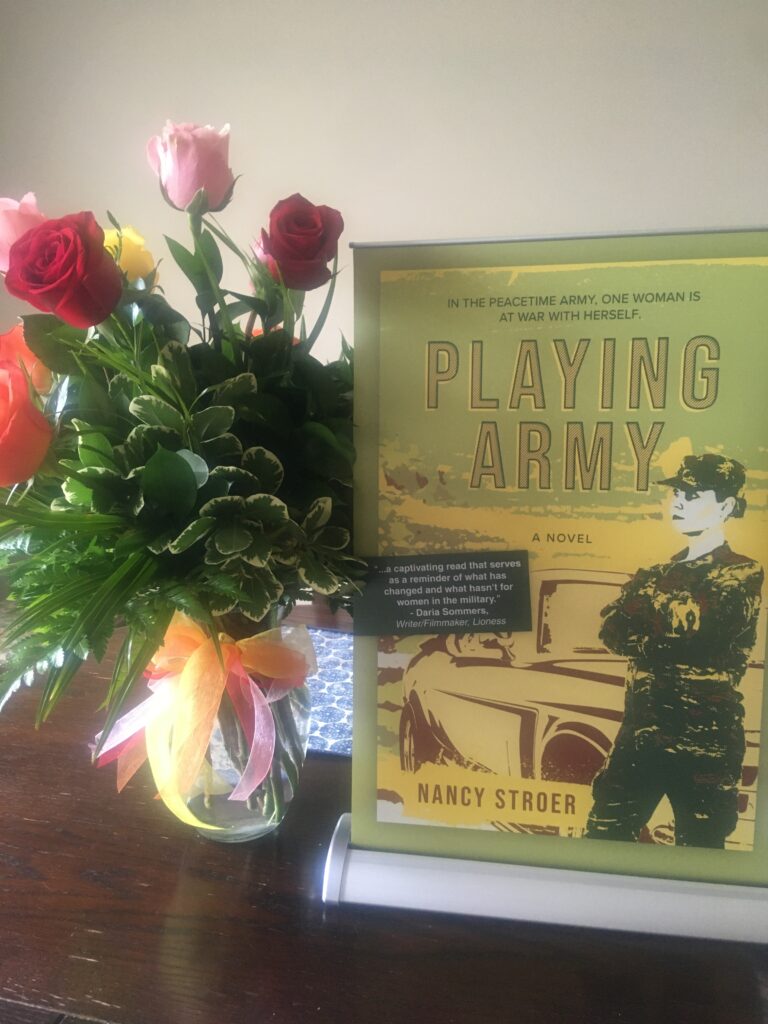
Videos of writers opening boxes of their books are A Thing. By now you’ve all seen the cover of Playing Army, but this is where I hold the physical book in my hand for the first time:
https://www.youtube.com/watch?v=NuKDmHRCgfQ
Yay! And thank you to Colette for making the video, but I wish we’d gotten the doggos on-screen, too. They were so hopeful that the box contained treats. I guess it was different kinds of treats!
And now a snippet of what DIDN’T make it into the box.
Earlier in the week my sister messaged me; she’d finished reading Playing Army and wanted to know how the reviews were supposed to work (just write whatever you want! It doesn’t have to be a book report – and nobody likes to read those, anyway, do they?). She also asked me about the short chapters told from the point of view of Indigo (the First Sergeant). Were they supposed to conclude in a clear way? Or was the point of them to make a case for why that character was so guarded?
No, I told her. I didn’t want to tell a complete story for Indigo, or for Logan. But the sensitivity readers* I’d worked with had all encouraged me to let these characters have their own lives on the page. To give them their own histories and communities, to not be afraid to show their complexity.
I told my sister that the Indigo chapters were part of a complete novel that I hoped someday might get its own book. But for now, I just wanted to intrigue you all with her, and her earlier life in Germany.
As for Logan, a sensitivity reader asked me (before Logan’s chapters were added), how Minerva felt about Vietnamese people in light of what had happened to Min’s father.
So here’s a vignette that got cut during one attempt to streamline my wordcount, that I originally wrote to answer that question. It, unlike most of the novel, is almost true to life from my own childhood:
“A forgotten memory surfaces, of Vietnamese children at my elementary school when I was eight or nine. The nuns hadn’t said we were getting new students, but three smiling, black-haired kids appeared one morning, sometime in the mid-70s. They couldn’t speak English but they knew the language of play. On the playground they tagged quickly, with a flash of white teeth and a confident toss of shining black hair. The girl was pretty, and my age, and the nuns said her name was “Tea**” although the girl bent the word in the middle and laughed when I got it wrong.
“Then one day, just as suddenly as they’d arrived, the Vietnamese families vanished, and again no one thought to inform us kids what was happening. Jennifer Whitten, whose mother was a teacher at the school, said they’d moved to California because there were more jobs for Vietnamese people there.
“I pictured Tea and her family crammed into boats like I’d seen on the evening news before my mother turned off the television. Walter Cronkite said a lot of people drowned, so many clinging to such small boats in all that water. Compared to that, to drive across America from Georgia to California would be easy. They wouldn’t starve or run out of drinking water or get eaten by sharks. But I wished that Tea’s parents could find work in Georgia. I would have liked a friend, another girl, who ran and played rough with the boys. I could have learned to say Tea’s name right. But Vietnam made people slip into and out of my life with no introduction and no goodbye, and after the refugee families left no one spoke about them again and I thought I might have dreamed them.”
(If you, like me, are interested in learning more about how the war(s) in Vietnam in the twentieth century impacted the country’s inhabitants, check out the Vietnamese Boat People podcast: https://www.vietnameseboatpeople.org/podcast)
I did check my facts with an acquaintance who’d been a teacher during those years and she said yes, a few students from Vietnam arrived suddenly in the mid-70s, and disappeared just as quickly – she thought within 2-3 weeks. A boy came to her second grade class whose name was Hoi (maybe actually Huy?). He couldn’t speak English, but for whatever reason he could read English aloud fluently (without comprehension). The other second graders were fascinated by Hoi/Huy, so much so that this teacher scolded them, “Hoi is a boy. Hoi is not a toy!” and then was immediately mortified by what had just come out of her mouth. But I think her sensitivity to how frightened he must have been, fleeing his home country and pitching up in another, only to be swarmed by strange-looking children who were (however well-meaningly) treating him like an object of curiosity, gets right back to what my sensitivity reader wanted to make sure came across in the story, which was that the Vietnamese characters in the story got to be fully human, too, and not just charming props.
Now I’m sort of thinking this memory should have stayed in, but oh, well – you will have to judge whether I’ve given Logan a life of her own on the page, and whether you think I’ve conveyed Min’s feelings about Vietnamese people without it. Plus, it’s sort of fun to tell you about the scenes that got cut!
Millions of thanks to those of you who are reading the advance copies and writing reviews, for your kind early words and enthusiasm. Just write the reviews! Don’t feel like you have to make them book reports!
Several of you have asked whether/how much of the story is autobiographical. What to tell you…or what never to admit… ?!
*Sensitivity readers are consultants and fact-checkers writers use to make sure they’re getting cultural details “right,” or at least nuanced and not stereotypical (or god forbid, downright harmful – see: all the romance novels where people in concentration camps fall in love with their SS guards. Yes, people write and publish that kind of nonsense!), especially for characters who come from backgrounds the writer isn’t personally knowledgeable about.
**Which would actually have been “Thuy”
I can’t access the video- I get a message saying it’s private. Can others see it?
Oh rats – I’m at work but the government computers block everything of course. I’m not very good at this but I’ll fix it!